

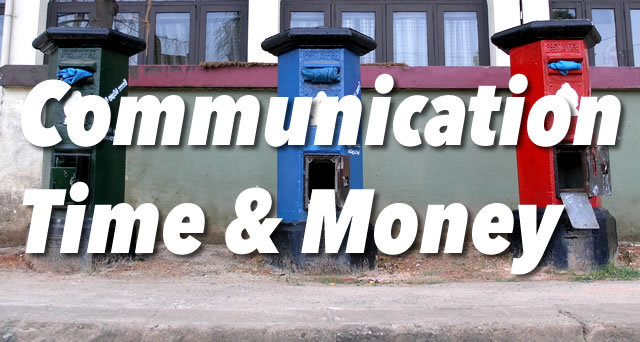
Communication, Time & Money
Communication & Media
The international country dialing code for Sri Lanka is +94. The outgoing code is 00, followed by the relevant country code (e.g. 0044 for the United Kingdom). Sri Lanka also has area codes. International direct dial facilities are available in Colombo and other major cities. Various mobile phone operators provide GSM 900 and/or 1800 frequency networks with coverage across all the main parts of the island. Internet cafes are available in the main towns and resorts.
Sri Lanka's media outlets are divided along linguistic and ethnic lines, with state-run and private operators offering services in the main languages.
Many of the main broadcasters and publications are state-owned, including two major TV stations, radio networks operated by the Sri Lanka Broadcasting Corporation (SLBC), and newspaper titles in Sinhala, Tamil and English.
.
Sri Lanka Currency
The Sri Lankan currency is the Rupee (LKR), divided in 100 Cents. The coins are in nominations of 50 Cents and 1, 2, 5, 10, 25 & 100 Rupees. The notes come in 10, 20, 50, 100, 500, 1.000, 2.000 & 5.000 Rupees.
Sri Lanka Time Zone
What's in half an hour? A lot more than only 30 minutes or 1,800 seconds — as Sri Lankans discovered in April 2006.
On 14 April 2006, the government adjusted Sri Lanka's standard time to GMT+5:30 from GMT+6, which had been used since 1996.
Tropical Sri Lanka gets about twelve hours of daylight year-round. For decades, the standard time was GMT+5:30 but in 1983, a government-appointed committee recommended changing this to make the island a full six hours ahead of GMT. In May 1996, the government, faced with a major electricity crisis, changed standard time to GMT+6:30 then readjusted it to the more convenient GMT+6 a few months later.
Some conservative Sri Lankans never accepted the change. This resulted in a hilarious situation of 'old time' and 'new time' coexisting for a decade. Meanwhile the Tamil Tiger rebels, who control parts of the country's north and east, defiantly continued to use GMT+ 5:30.